Production line
An everyday object, made the industrial way.
A desk pen holder is simple enough to understand in a morning and complete enough to need every part of a production line: processing, assembly, marking, testing, packing and storage, one module per step.
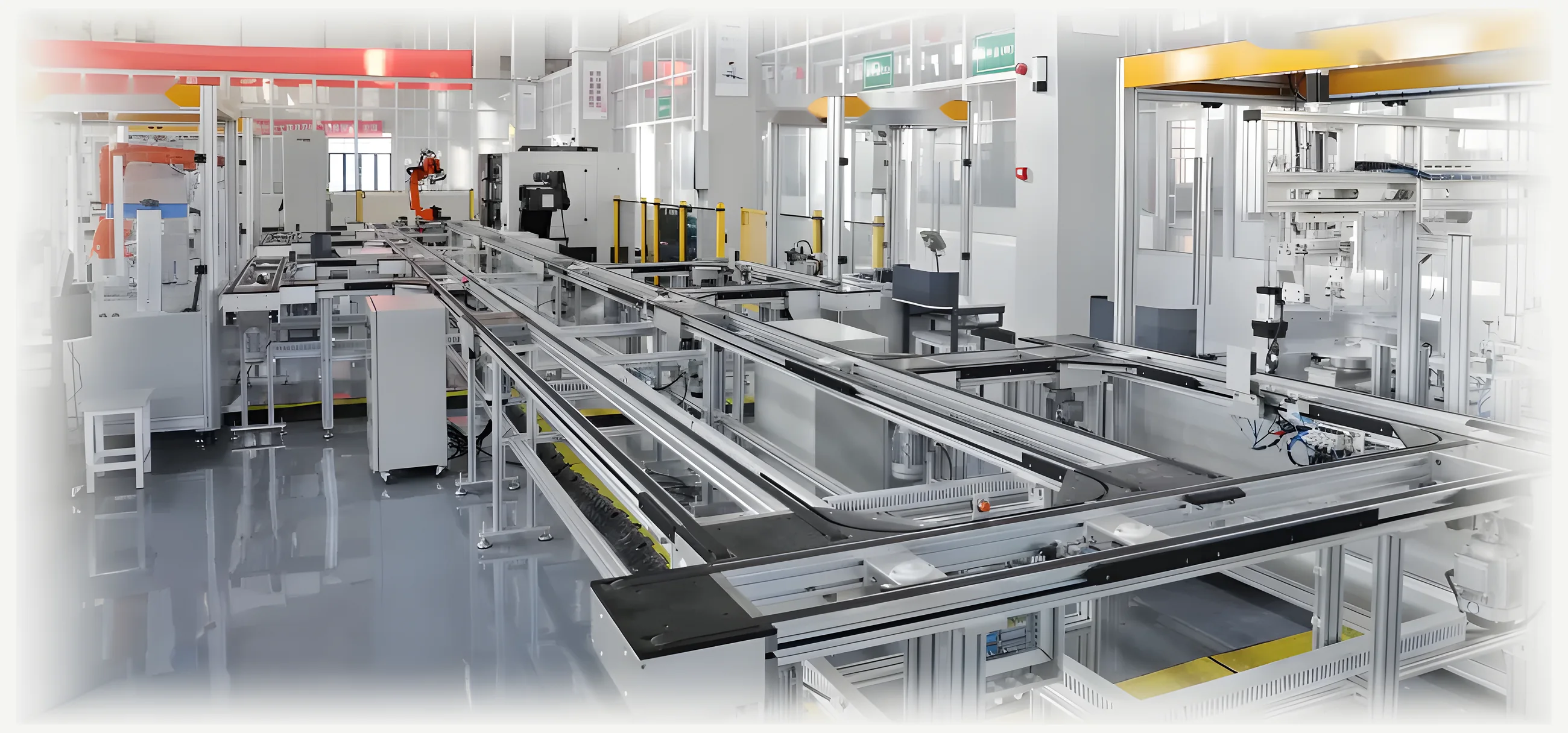
Follow one order.
Eight stops from a blank to a boxed pen holder back on the shelf.
Order. An order arrives at the control and display center, which releases the job and follows it around the loop.
Built from industrial equipment.
Real machines
Industrial controllers, drives, sensors and a vision system on every module, so what students learn transfers straight to a plant floor.
Modular by design
Six stations on casters. Teach one module on its own, pair two, or run the full line; every module has its own controller.
A digital twin
The line exists in simulation, so students can program a sequence and prove it virtually before loading it on the real stations.
The smallest footprint
The line that fits a classroom-sized room, which makes it the usual first floor for a program that is starting out.
What students do on it.
Mechanical, electrical, pneumatic and controls work, grouped by what a technician actually touches.
Controls. PLC programming, HMI screens, sequencing a station, fieldbus and industrial networking.
This is the floor where semesters three to five happen. See the curriculum
At a glance.
- Product
- A desk pen holder, assembled and marked to order
- Stations
- Processing, assembly, laser marking, testing, packaging, inkjet coding and scanning
- Logistics
- Automated store, conveyor loop with pallets, RFID tracking
- Control
- Master control and display center; digital twin platform; one controller per module
- Footprint
- 36 × 24 ft of equipment (11 × 7.3 m), including a 5 ft walkway around it
- Power
- Connected load up to 12 kVA, three-phase
See the Pen Holder line run.
A walkthrough shows the line in production, the classrooms and trainer labs beside it, and the course plan in hand.
Book a Walkthrough